
Temporary Staff – Managing them well

Temporary staff can be needed for a variety of reasons. Peak season? Staff member on Maternity Leave? Sometimes a temporary staff member is necessary to ease the load of your current staff complement or to fill a gap during an extended leave of a permanent employee. It may be a short-lived arrangement but it’s important to treat them well. We’ve put together a list of key points to ensure that once you’ve parted ways, it leaves their (and your) experience a good one. KNOW WHAT IT IS YOU REQUIRE What do you require from a temporary staff member? Make a list of duties they will need to Make it clear whether you have any intention of having them fill a permanent role at a later stage. Set clear guidelines and expectations. It will ensure that there is no uncertainty from either side. COMMUNICATE YOUR INTENTION OF RECRUITMENT TO EXISTING STAFF If you will be taking on the temporary staff permanently, let your current staff know. Ensure that the team the temp will be a part of, understands your reasons and assign someone senior to guide them through the processes. A surprise temp may not be as well received. As much as the temp employee is there to help, your staff may feel that you think them incapable of meeting the requirements in their department. TREAT THEM AS PART OF THE TEAM Their stay may not be a lengthy one but ensure that you treat them the same as you would your permanent staff. For as long as they are there, celebrate their achievements and encourage them as you would the rest of your staff. KEEP RECORDS Keep a record of the timekeeping, enthusiasm and competency of your temporary employee. If a position becomes available within your organisation, you will have a “pre-qualified” candidate. One who has had practical experience in a trial run, and may be ready to fill the slot quickly. To find staff – be sure to link through here or follow up on our social platforms.
Do you have Substance Abuse Policies in place?

The matter of Mthembu and 2 others v NCT Durban Wood Chips (September 2018), showed us that employers and the CCMA have zero tolerance when it comes to substance abuse, and that policies are required to be in place. The facts were laid out like this as to why the CCMA agreed that the 3 employees were fairly dismissed: The employers business has dangerous and large machinery moving in and around their premises on a daily basis, such as a clipper that rotates at 5000RPM, and as these employees jobs were directly related to these machines, there was the danger of them causing harm to themselves and others, never mind damage to the machinery Their jobs were of a log deck assistance, a knife sharpener and a weigh-bridge operator, which further impacted that their ability to perform these roles could be impacted by being under the influence of cannabis They had received the substance abuse policy and they had regular discussions around the matter within their groups, so there was no excuse for claiming to not understand the rules If you don’t have the correct policies, practices and procedures in place, you may be opening up your company to legal claims, and of course the possibility of health and safety issues. While the private cultivation and use of cannabis have been passed, it does not allow for use when it impacts on the health and safety of others, especially in a work environment. Download the Substance Abuse Policy should you not have this in place yet. West Coast Personnel are always finding ways to assist employers so that they stay on the straight on narrow. If you have any queries on what you need in place, please reach out today. To find staff – be sure to link through here or follow up on our social platforms.
Job Shadowing – Take our tips and do it like a boss
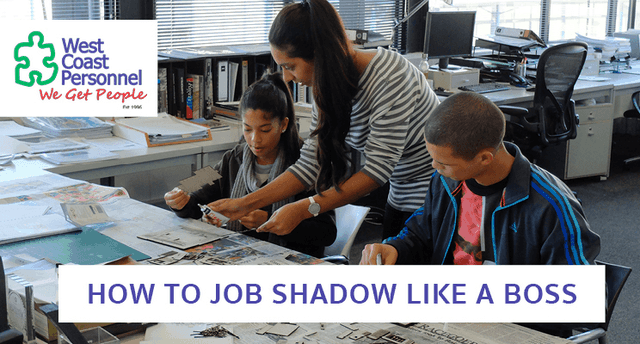
Job shadowing can be daunting. You are there to observe and learn, and most times you can feel like you are in the way. Job Shadowing like a boss UNDERSTAND THE JOB PARAMETERS BEFORE YOU ARRIVE Do some research beforehand. Sure, you are there to learn, but knowing a bit about the position will help you feel less nervous and also look more efficient and proactive. HAVE A SET OF QUESTIONS READY TO ASK What you don’t understand is best covered by asking. Don’t be too overzealous with the questions though – you don’t want to irritate – remember whomever you are shadowing has to actually do their job whilst you are there. Keep the questions to a minimum and make them count. ASK HOW YOU CAN MAKE THEIR DAY EASIER Job shadowing is also about assisting, as this is the best way to learn. So, ask them upfront, before you start, how you can help them make their day easier. They will appreciate your presence more if you are taking a load off their plate too. KEEP A NOTEPAD AND PEN HANDY You are not expected to remember everything you are shown, so be sure to write it down. It would be super irritating if you kept asking the same questions, and if you are there to eventually take over that position, you don’t want to be bugging others about what to do. BE INTERACTIVE WITH OTHERS Besides the person you are job shadowing, speak to the other employees. Ask them how they enjoy working there, how long have they been there, and what they do exactly. Remember, you will be working with these people going forward. Make nice now. PUT YOUR PHONE AWAY Sitting on your phone, taking calls, or scrolling through Facebook is not going to help you. And, it will look really bad to the boss and to the others who are actually working. Slip that phone into your bag or pocket and forget about it. When you are given a break, then you can walk away to a private area and do your thing. BE POSITIVE AND FRIENDLY Put a smile on your dial and make the most of your time there. You never know where a job shadow will lead you, so be the best you can be at the moment in time. And … good luck! Be sure to follow us on Facebook!
WHAT KIND OF LEADER ARE YOU?

A leader comes in many shapes and sizes. Knowing which one you are can help you lead better. There are commonly 8 leadership styles – we explore these: 8 LEADERSHIP STYLES 1. Transformational Leader Innovation and change is a big part of this leadership style. These leaders want to encourage growth and ideas within their followers. 2. Democratic Leader This leader wants to bring in their sheep to participate. They are open to “the more the merrier” and believe that strength and growth come in numbers. They are very team led. 3. Bureaucratic Leader ‘By the book’ is a phrase that resonates with this type of leader. They want to follow a set of rules and do it right. They are not very forgiving when the rules are bent or broken. They believe that everything and everyone belongs in a box and that this is what works best. 4. Transactional Leader With this leader, they will give but they do expect something in return. There will always be a transaction or trade taking place here. 5. Servant Leader Some may get confused whether this person is a leader at all, as they always seem to be doing things themselves. But, their belief is that if they serve, the rest will follow in likeness. 6. Autocratic Leader The opposite of the democratic leader – they want it all to go their way. The term, ‘my way or the highway’ comes to mind here. 7. Hands-off Leader With an attitude that people are more capable when they are left to do things their way, this leader is very much a hands-off type of person. They give their followers the tools and then oversee that all is going according to plan. 8. Charismatic Leader You know this type well and their qualities are often resident in most styles of leadership. But, this character leads by magnetism. People just want to do whatever they say because they are that charismatic. You will know where you fit in and for some styles, there is always some improvement needed. Get in touch at https://westcoastpersonnel.co.za/find-staff/. Follow us on Facebook to keep up to date.
HAPPY YOU – HAPPY WORK – MAKE THE MOST OF WORK LIFE

No way around it – you have to work, and for a good part of your life, and mostly this will be for someone else. So, you may as well make the most of it, and be happy! Easier said than done, especially if you are not working in a job that you like, if what you’re doing is not your passion, and if the conditions are not good. But, it really does come down to attitude and perception. What do we mean? The way that you look at something and the way you perceive it can change your mind about it 100%. Finding the meaning and value in every task, every action and every moment, can release you from the chains of negativity and unhappiness. This doesn’t only apply to work but in life in general. But, let’s start with work, as you will be spending most of your adult life here. First, ask yourself why you are there. It could be a means to an end i.e. pay the bills, ensure your family doesn’t suffer, or you’re studying and need a job. Or maybe its a stepping stone in your career path. Those reasons, whatever they may be, should be a motivation for you to move through your workday with easier steps. Then look at each and every task you take on. What meaning can you find in the task itself? Sure, it may not add value to you directly, at that moment, but the task is a stepping stone in a bigger pond. The business you work for needs that task to be done and to be done well in order to complete a puzzle. Your input is part of that puzzle building, and in the end, fulfilling an integral need the business has. You are an important element in that project. Getting that will help you on your way to happy. You need to look at the job at hand, and even if someone else could do that job, you have to do it so well, that you know no one could have done it better. In that way, you have put yourself at the top of the food chain. You have become indispensable to the company when you offer value, even if it is through a mundane and boring task. Your input can also have positive repercussions that will affect other people in the business. Most activities are part of a team effort even if you never deal with the other people. There is rarely an activity that requires only one single input. Writing an order needs to then go to the person that will place the order, then to the one that will pick the order, check it and on to delivery. Mundane as it may be, you are all cogs in a working machine. Are you going to be the happy part of this process? Attending a meeting where you feel inadequate and useless could be because you are not adding value. Before the meeting, think about how you can add value. What can you bring to the table? How can you leave the room afterwards having them wonder where that came from and when will they see more? You can be your own worst enemy and making a difference is always up to you. There is always a bigger picture. Find that bigger picture and know that all the smaller paint swipes are just to build up to the finished artwork. Follow us on Facebook to keep up to date with news.
SLOW RECRUITMENT PROCESSES LOSE HOT PROSPECTS

I just had a client request a meeting with a star candidate I recommended to them four weeks ago and low and behold I had to let them know that the candidate had started work with an opposition company a week ago. WHY? Slow recruitment processes! This is not a once off. It occurs at least twice a week. I am sure that all HR and Recruitment Consultants who hunt top talent have experienced this. I understand that big companies often have more red tape and recruitment processes to follow. I also understand that it is difficult to get panels together and difficult to get signatures of authorisation for interviewing candidates, but at what price? There is a war for talent and if you don’t re-look your selection process you will not get the top 5% of candidates in your industry, but rather candidates who are available and definitely not the best for the business. Top talent has at least 3 offers or interviews in recruitment processes. They are being hunted daily and when they make the decision to move companies, they do have options. It is no longer a market where candidates are desperate and will wait 3-4 weeks for an interview. Skill shortages is not just a South African issue, it’s global and yes, we are losing the war. The root of unemployment is not only a lack of jobs, but a key underlying issue is also the inadequately educated workforce. Companies who understand that top talent do not stay looking for work for long, have a distinct advantage. Those companies who have tailored their recruitment processes to see top talent quickly, are those companies who are beating you to the candidates. Many firms now go the first step and track some variation of the “time-to-fill” metric. But despite that metric, not only are firms still almost universally guilty of painfully slow hiring but to compound the problem, few recruiting leaders truly understand the many negative recruitment processes that impact and result from slow hiring process timeline. I estimate that the impact at most corporations exceeds tens of millions of rand’s each year and the rand loss from this factor may be as much as 10 times higher than losses resulting from low recruiting efficiency related to the more popular “cost-per-hire” metric. It’s not enough to be conscious and aware of slow hiring. Identify and then quantify in rands each of the negative impacts of slow hiring, so that everyone from the CEO down will support the streamlining of the recruitment process. A big misconception that needs to be addressed is the old-fashioned way of thinking is that a slow recruitment process improves the quality of those you hire. You will lose most of the candidates who are in high demand during the late stages of your recruitment process. You also will lose significant revenue and productivity because vacant positions are open for too many days and essentially you end up paying new hires more in salary because they will be bid on by opposition. Your image of being slow decision-makers will cause you to lose many top prospects. Recruiting is a lot like acquiring a Grade 12 dance date. If you wait 40 days to make a selective decision, you must realize how relatively “ugly” your new hire is likely to be! Connect with us should you need help in moving swifter in your recruitment process.
WHY IS THERE A BATTLE FOR TALENT?

Skill shortages are not just a South African issue, it’s global and yes, we are losing the war trying to find talent. South Africa’s unemployment rate rose to 27.5% in the third quarter of 2018 from 27.2% in the second quarter. There were 6.2 million jobless people in Q3/2018; about 100 000 more than in Q2/2018. The unemployment rate is 37.3%, including people who have stopped actively looking for work. The issue is that most of these unemployed people are part of the inadequately educated workforce. Many students currently enrolled in South Africa’s tertiary institutions are studying subjects that do not support the need in business for science, technology, engineering and maths (STEM) as well as future-orientated skills. The unemployment rate in South Africa remains one of the highest in the world, yet over the past year it has become more difficult to fill positions, with the demand for Engineers, IT staff, and skilled Trade-Workers at its highest. South Africa has a shortfall of about 40 000 qualified artisans. While government has started to actively encourage young South Africans to choose trade jobs, they’re also filling skills gaps in the trade with professionals from abroad. Survey shows skilled trades remain in the top three most difficult positions for companies to fill, followed by engineers. Pertaining to IT, actual coding experience can become more valuable than traditional qualifications. After all, you learn through working and sometimes traditional education simply can’t prepare you for the world of work. In a world of fast-paced technological advancement, more and more IT skills are needed to keep up with the demands of a changing global marketplace. In South Africa, in particular, there is a lot of discussion around the lack of IT skills in the local job market. As skill needs change rapidly employers are looking inside their organisations for solutions, with more than half choosing to develop and train their own people. Production and machine operators also become tougher roles to fill. As the talent shortage escalates, employability not only depends now on what you know, but on your ability to learn, apply and adapt to the constantly evolving business landscape. Is paying higher salaries the answer? Companies have budgets and need to remain profitable, getting into a salary war with competitors could prove counterproductive. Building the right talent for Africa’s jobs of today and tomorrow is therefore critical.
HOW TO SURVIVE THAT END OF YEAR PARTY

We know why companies put these end of year office party things together. They want to thank you for your hard work in the year and get the employees to socialise other than on a work level. We understand, but many find this time of the year and the social aspect of an office party with colleagues stressful. The mix of finger foods, eating etiquette (or the lack thereof), alcohol and finding something to talk about other than work, can cause high blood pressures and serious phobias. So, how can you survive that end of year office party? You want to be part of the office fun, but still keep face and professionalism, so here’s how. 1. Consider how alcohol affects you If badly, then rather err on the side of caution, and don’t have any. While we know that it will loosen you up and help you to relax, it can go pear shaped if you have too much. If you can handle your liquor, be sure to stick to one type. Mixing drinks doesn’t work for anyone. 2. Take someone with you If your office party allows partners, then take someone with you that you know will unfreeze the crowd and help you to blend in nicely. They can also keep you company when there is a lull in the conversation. 3. Think of pieces of conversation starters before hand if you don’t find it easy to start up a conversation, make a list of topics that others would find interesting, and that will spur on a debate. It is also safer to steer clear from religion, sex and politics. These subjects always tend to stir up the blood and generally never end well. Stick to topics around entertainment, business, relationships and more importantly, things that you know well. 4. Keep it professional While it is easy to lay it thick on the friendly-mode and of course, alcohol will spur that on, keep it professional. You have to face these people on Monday again and you don’t want to be labelled the party animal, wall-flower or worse.